

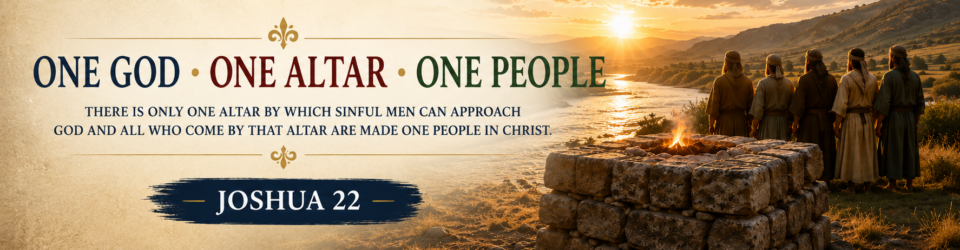
Text: Joshua 22
Theme
There is only one altar by which sinful men can approach God and all who come by that altar are made one people in Christ.
Introduction
The last several chapters have dealt with the dividing of the land for an inheritance among the tribes of Israel and the last two chapters dealt more specifically with the cities which were given to the tribe of Levi.
As we come to chapter 22, we are only a few chapters of finishing out our series on the book of Joshua which has 24 chapters.
With the book drawing to a close, it makes sense that the focus of these last three chapters is no longer on obtaining the inheritance, but rather, on how Israel would live within their inheritance going forward.
Chapter 22 is all about worship and national unity.
The chapter focuses on an altar, the purpose of which was initially misunderstood by the tribes West of Jordan.
The lessons that we learn from the chapter are that there is only one God (Deuteronomy 6:4), there is only one mediator between God and men (1 Timothy 2:5), and there is no division in the body of Christ (1 Corinthians 1:13).
For the study this morning, I will give a short overview of the chapter and then we will look at the three lessons we can see in the chapter under these three headings:
- One God
- One Altar
- One People
Chapter Overview
The Occasion for the Altar
At the beginning of chapter 22, we find that Israel has divided the Promised Land among the tribes.
The nation is, in general, at rest.
The army of Israel is no longer carrying out the general conquest of the land however, as we noted last week, there were still cities that lay within the individual territories of the tribes that still needed to be conquered.
With the general conquest having been accomplished and the nation now living in the land, Joshua dismissed the men from the tribes of Ruben, Gad, and half of Manasseh from their military service.
You will recall that, when these three tribes had requested the land in the East side of the Jordan river, Moses has granted their request, provided they assisted their brethren in conquering the rest of the Promised Land.
In verses 2-3 Joshua commended them for keeping their word and for being obedient to everything that Joshua commanded them.
This was commendable behaviour.
They could have been reluctant to fulfill their promise and tempted to go home and take it easy in their own inheritance, but they kept their word and fought alongside their brethren so that their brethren might enter into rest in their inheritance also.
This is the unity that ought to exist among God’s people in the local church. Today we fight and labour together and one day we’ll rest together in glory.
Hebrews 4:11
“Let us labour therefore to enter into that rest.”
In verses 4-8 Joshua blessed these three tribes and sent them away to return to their tents.
The Misunderstanding of the Altar
In verses 9-30 we have the account of a misunderstanding regarding an altar that was built on the west bank of the Jordan river.
As the three tribes of Ruben, Gad, and half of Manasseh returned to the east side of the Jordan river, they stopped to build an altar on the west as a sign of their identification with the tribes on the west side of the Jordan.
In verses 24-28 we find the reason given behind the building of this altar was not so it could used for sacrifices but so it could stand as a testimony of the fact that these three tribes on the east of the Jordan river were united with the tribes on the west of the river in their worship of Jehovah, God of Israel.
The problem was that the other tribes misunderstood the purpose of the altar and believed that these three tribes had already begun to depart from the true worship of Jehovah.
In verses 11-20, this is the very accusation they brought against the three tribes on the east of Jordan, and their fear was that these three tribes would brings God’s judgement upon all of Israel because of their departure from the true worship of God.
After the tribes of Ruben, Gad, and half of Manasseh explained the purpose of the altar, the other tribes were pleased with the explanation they gave, and a civil war was averted. (Vs 30-34)
One God
The God of Israel
The LORD Is One God
The fact that Jehovah was the only God to be worship in Israel is stated multiple times through this chapter. (Remember that whenever you see the name LORD in all caps, that is the name Jehovah in the Hebrew.)
Joshua 22:5
“But take diligent heed to do the commandment and the law, which Moses the servant of the LORD charged you, to love the LORD your God, and to walk in all his ways, and to keep his commandments, and to cleave unto him, and to serve him with all your heart and with all your soul.”
Joshua 22:18
“But that ye must turn away this day from following the LORD? and it will be, seeing ye rebel to day against the LORD, that to morrow he will be wroth with the whole congregation of Israel.”
Joshua 22:22
“The LORD God of gods, the LORD God of gods, he knoweth, and Israel he shall know; if it be in rebellion, or if in transgression against the LORD, (save us not this day,)”
All of Israel served the one God.
Deuteronomy 6:4-5
“Hear, O Israel: The LORD our God is one LORD: And thou shalt love the LORD thy God with all thine heart, and with all thy soul, and with all thy might.”
The God of Abraham, Isaac, and Jacob
The nation of Israel has been God’s chosen nation ever since he had his covenant with Abraham.
Genesis 17:7-8
“And I will establish my covenant between me and thee and thy seed after thee in their generations for an everlasting covenant, to be a God unto thee, and to thy seed after thee. And I will give unto thee, and to thy seed after thee, the land wherein thou art a stranger, all the land of Canaan, for an everlasting possession; and I will be their God.”
The God of their fathers Abraham, Isaac, and Jacob was the God of Israel. He had not changed and his promises had not failed.
The God of Today
The God of Israel in the Old Testament Is the God of the New Testament Church
Many people have a sort of notion that either the God of the Old Testament was a different God, or He was a different version of God, to the one we worship today.
They see that the God of the Old Testament sent his people Israel to conquer other nations and establish a kingdom on earth and they figure that, since God isn’t commanding us to do that today, something about God must have changed.
While God has not changed, his dealing with men have changed. In this church age, the church is not seeking to establish an earthly kingdom but to build the heavenly one and, as such, we don’t look to conquer earthly kingdoms.
The LORD (Jehovah) who Abraham worshiped is the same LORD we worship today.
Malachi 3:6
“For I am the LORD, I change not;”
James 1:17
“Every good gift and every perfect gift is from above, and cometh down from the Father of lights, with whom is no variableness, neither shadow of turning.”
One Altar
The Altar of Israel
The concern that the other tribes had was, not that Ruben, Gad, and half of Manasseh had begun to worship another God, but that they had begun to worship Jehovah differently from what He had commanded.
Deuteronomy 12 repeatedly warns against setting up altars and groves unto the Lord as the heathen did and instructs Israel to come to God’s chosen tabernacle to worship Him.
Deuteronomy 12:14
“But in the place which the LORD shall choose in one of thy tribes, there thou shalt offer thy burnt offerings, and there thou shalt do all that I command thee.”
The LORD had given Moses the instructions for the Tabernacle along with the golden menorah, the Ark of the Covenant, and the brazen altar.
The only acceptable place to offer sacrifices to Jehovah was in the Tabernacle, on the brazen altar, and with the aid of an Aaronic priest.
For Israel there was to be only one altar, God’s chosen altar, upon which they would offer their sacrifices. This is why the other tribes were so concerned when they heard another altar had been established on the banks of the Jordan river, because they thought Ruben, Gad, and half of Manasseh planned to use this altar for their sacrifices, so they wouldn’t have to come up to the tabernacle at Shiloh.
Joshua 22:16
“Thus saith the whole congregation of the LORD, What trespass is this that ye have committed against the God of Israel, to turn away this day from following the LORD, in that ye have builded you an altar, that ye might rebel this day against the LORD?”
As outlined in verses 17-20, this was a serious accusation which, if true, the other ten tribes were perfectly right in trying to put an end to this altar before the wrath of God came upon them all.
There Is a Right Way to Worship God
These tribes understood that there is a right way to worship God and any other way is a man-made religion and God is not pleased with man made efforts to worship Him.
Something we all must understand is that you can be putting you all into attempting to worship God but if our worship wasn’t produced by the Holy Spirit in the first place, then it is man’s efforts and therefore it is of no value to God.
Only worship that is sanctified by God can ever be pleasing to our holy God.
John 4:23
“But the hour cometh, and now is, when the true worshippers shall worship the Father in spirit and in truth: for the Father seeketh such to worship him. God is a Spirit: and they that worship him must worship him in spirit and in truth.”
The Altar for the Sinner
Today, there is still only way altar which God has ordain on which an offering for sin has been made and by which we may worship God aright.
Today, people are obsessed with finding their own way to God.
Many believe that if they just do their best to be a good person then they will work out the rest of their salvation once they get to heaven and hopefully their good works will outweigh their wicked deeds.
There are literally hundreds, if not thousands of religions out there promising a peaceful afterlife in some type of heaven. For most people, they believe that all roads lead to God and it doesn’t really matter which road you choose so long as you are committed to living a good life and pursuing your chosen religion.
In truth, there is only one way to come to God and that is through Jesus Christ.
1 Timothy 2:5-6
“For there is one God, and one mediator between God and men, the man Christ Jesus; Who gave himself a ransom for all, to be testified in due time.”
There is still only one altar at which the sacrifice for man’s sin has been made and no other sacrifice for sin will be accepted in God’s eyes. Jesus Christ is the only God ordained, God approved sacrifice for sin.
Hebrews 10:10
“By the which will we are sanctified through the offering of the body of Jesus Christ once for all.”
Acts 4:12
“Neither is there salvation in any other: for there is none other name under heaven given among men, whereby we must be saved.”
If you have never come to God by the way of the blood of Jesus Christ for forgiveness of sins then let me tell you today, there is no other way for you to have your sins forgiven.
God will not accept any other attempts to enter into His heaven. God will not forgive sins on the basis of any other good work my might do in this life. The only basis for forgiveness of sins the blood of Jesus Christ.
Acts 17:30
“And the times of this ignorance God winked at; but now commandeth all men every where to repent: Because he hath appointed a day, in the which he will judge the world in righteousness by that man whom he hath ordained; whereof he hath given assurance unto all men, in that he hath raised him from the dead.”
One People
The People of the Altar
While the Jordan river created a geographical separation between the tribes of Israel, they were still one nation and one people in God’s eyes.
The reason behind the building of the altar on the banks of Jordan was quite a reasonable one.
The 3 tribes on the east of Jordan were concerned that in times to come the western tribes would use the geographical separation to create a religious separation also. That is why they erected an altar on the west of Jordan, which was an “altar to see to” (Vs 10), meaning it stood out and could been seen from afar off.
This altar on the west of Jordan was to be sign of the fact that Ruben, Gad, and half of Manasseh were identifying themselves with the rest of Israel and, specifically, with the God of Israel.
The eastern tribes made it clear that this altar was an altar of remembrance, not an altar for the covenant sacrifices.
Joshua 22:22-23
“The LORD God of gods, the LORD God of gods, he knoweth, and Israel he shall know; if it be in rebellion, or if in transgression against the LORD, (save us not this day,) That we have built us an altar to turn from following the LORD, or if to offer thereon burnt offering or meat offering, or if to offer peace offerings thereon, let the LORD himself require it;”
This altar was specifically for the purpose of identifying the easter tribes with the LORD God of Israel.
Joshua 22:27
“But that it may be a witness between us, and you, and our generations after us, that we might do the service of the LORD before him with our burnt offerings, and with our sacrifices, and with our peace offerings; that your children may not say to our children in time to come, Ye have no part in the LORD. Therefore said we, that it shall be, when they should so say to us or to our generations in time to come, that we may say again, Behold the pattern of the altar of the LORD, which our fathers made, not for burnt offerings, nor for sacrifices; but it is a witness between us and you.”
Although separated geographically, the people of God were all one people and they all possessed one altar unto the one true God.
There Is No Division in Christ
1 Corinthians 1:13
There Are No Elite Christians
There are no special category Christians in the local church.
Colossians 3:11
“Where there is neither Greek nor Jew, circumcision nor uncircumcision, Barbarian, Scythian, bond nor free: but Christ is all, and in all.”
The three tribes of Ruben, Gad, and half Manasseh were concerned that the rest of Israel would use a geographical distinction to create a religious distinction.
Apostle Paul warned against using physical distinctions to create a spiritual or religious distinction. No one Christian is better than another because of his location, his ethnicity, or any other factor.
When you are saved you are in Christ and he is our all in all, and nothing else matters.
There Are Only Saved Sinners
It doesn’t matter who you are or where you’ve come from, if you are saved by grace then you are in the position as the rest of us.
Even the Apostle Paul, probably the greatest Christian who ever lived, said:
1 Timothy 1:15
“This is a faithful saying, and worthy of all acceptation, that Christ Jesus came into the world to save sinners; of whom I am chief.”
In Christ, there is no room for boasting. We are all on even turf as it were. To be in Christ is a blessed standing to be sure but you are no better off in Christ than the next person.
It doesn’t matter if you were saved before them or how many years your been a faithful Christian for, at the end of the day we are all nothing without Christ.
In this local church we are to be one people, who have come to God by the one altar, which is the cross of Jesus Christ and his shed blood, and there we worship one LORD and God.
Conclusion
One God – One Altar – One People
It is important that we worship God appropriately, in the way that he desires, and as we do that, you and I find ourselves on equal ground.
Hebrews 10:19-23
“Having therefore, brethren, boldness to enter into the holiest by the blood of Jesus, By a new and living way, which he hath consecrated for us, through the veil, that is to say, his flesh; And having an high priest over the house of God; Let us draw near with a true heart in full assurance of faith, having our hearts sprinkled from an evil conscience, and our bodies washed with pure water. Let us hold fast the profession of our faith without wavering; (for he is faithful that promised;)”